What can cause a positive DAT?
 Robert Bradley
 .
Hereof, what is a false positive DAT result?
DAT is used to detect antibodies (autoantibodies or alloantibodies) and complement on RBCs. A positive DAT result may or may not be associated with hemolysis. The DAT is best interpreted with regard to levels of RBC-bound immunoglobulins and the various clinical situations that can lead to a false-positive result.
Additionally, what is a DAT test for? The direct antiglobulin test (DAT) is used to determine whether red blood cells (RBCs) have been coated in vivo with immunoglobulin, complement, or both. The direct antiglobulin test is sometimes colloquially referred to as the Coombs test, because it is based on a test developed by Coombs, Mourant, and Race.
Consequently, which situation will cause a positive DAT in the newborn?
Coombs (DAT) positive babies are at risk for anemia; most do not become anemic. Jaundice is a yellow color to a newborn's skin and the white parts of the eyes. Almost all newborns develop mild jaundice.
What does a positive Coombs test indicate?
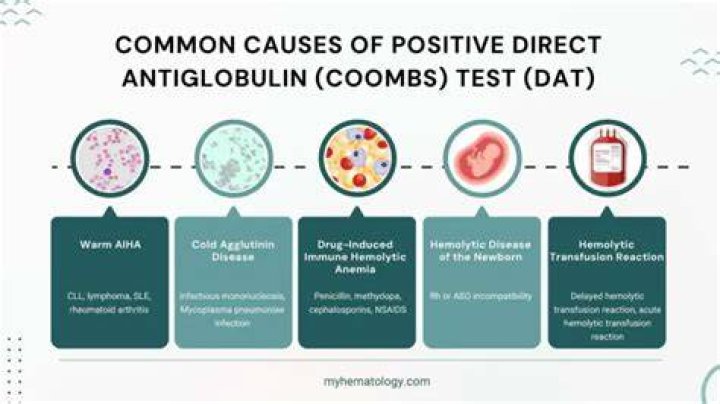
An abnormal (positive) direct Coombs test means you have antibodies that act against your red blood cells. This may be due to: Autoimmune hemolytic anemia. Chronic lymphocytic leukemia or similar disorder.
Related Question Answers
What does a positive direct antiglobulin test mean?
A positive antiglobulin test may mean: Reaction to a blood transfusion. Autoimmune hemolytic anemia. Hemolytic disease of the newborn. Hemolytic anemia caused by reactions to medicines.What causes a positive Coombs test?
Abnormal. Direct Coombs test. A positive result means your blood has antibodies that fight against red blood cells. This can be caused by a transfusion of incompatible blood or may be related to conditions such as hemolytic anemiaor hemolytic disease of the newborn (HDN).What is dat IgG?
Direct Antiglobulin Test (DAT) The DAT is a serologic procedure that is used to detect in vivo binding of IgG antibody and/or complement on the red cells (in vivo sensitization of RBCs).Can you get rid of antibodies?
Antibodies can be difficult to remove from the body, although different treatments have been tried. Antibody levels can temporarily increase in the setting of infection, vaccination, or transplantation. The cPRA is used in the allocation of kidney and pancreas transplants.How is direct Coombs test done?
For the direct Coombs' test, blood is drawn from the vein in your arm and then “washed” to isolate your red blood cells. The red blood cells are then incubated (combined in a controlled environment) with a substance called Coombs' reagent.How do you do dat?
The test is also known as the “Direct Coombs” test or simply by the abbreviation “DAT.” The test tube version of the DAT is done by washing a patient sample of red cells to rid the sample of unbound antibody and complement, adding anti-human globulin (AHG), centrifuging briefly, and examining for agglutination.What is dat medical terminology?
Direct agglutination test, any test that uses whole organisms as a means of looking for serum antibody. Direct antiglobulin test, one of two Coombs tests.How long is Coombs test?
It'll need to remain in place typically for 10 to 20 minutes.What is Coombs disease?
An abnormal (positive) direct Coombs test means you have antibodies that act against your red blood cells. This may be due to: Autoimmune hemolytic anemia. Chronic lymphocytic leukemia or similar disorder. Blood disease in newborns called erythroblastosis fetalis (also called hemolytic disease of the newborn)How does ABO incompatibility happen?
ABO incompatibility is one of the diseases which can cause jaundice. ABO incompatibility happens when a mother's blood type is O, and her baby's blood type is A or B. The mother's immune system may react and make antibodies against her baby's red blood cells.What is Rh incompatibility?
Rh incompatibility is a condition that occurs during pregnancy if a woman has Rh-negative blood and her baby has Rh-positive blood. "Rh-negative" and "Rh-positive" refer to whether your blood has Rh factor. Rh factor is a protein on red blood cells.What happens when mom and baby have different blood types?
If a baby's and mother's blood are incompatible, it can lead to fetal anemia, immune hydrops (erythroblastosis fetalis) and other complications. The most common type of blood type incompatibility is Rh disease (also known as Rh incompatibility). The Rh factor is a protein on the covering of red blood cells.What does a positive indirect Coombs test mean in pregnancy?
An indirect Coombs test can be used to determine whether there are antibodies to the Rh factor in the mother's blood. An abnormal (positive) result means that the mother has developed antibodies to the fetal red blood cells and is sensitized.What is the difference between jaundice and hyperbilirubinemia?
Hyperbilirubinemia is a condition in which there is too much bilirubin in the blood. When red blood cells break down, a substance called bilirubin is formed. Because bilirubin has a pigment or coloring, it causes a yellowing of the baby's skin, eyes and other tissues. This is called jaundice.What is the difference between Rh incompatibility and ABO incompatibility?
ABO CompatibilityIt occurs when the mother is type O and the baby is A, B, or AB. As with Rh incompatibility, this means that the mother's immune system does not recognize the A or B antigens and will see them as foreign substances that trigger an immune response and an attack.What is Rh Isoimmunization?
Isoimmunization (Sometimes called Rh sensitization, hemolytic disease of the fetus, Rh incompatibility) What is isoimmunization? A condition that happens when a pregnant woman's blood protein is incompatible with the baby's, causing her immune system to react and destroy the baby's blood cells.What is the difference between direct and indirect Coombs test?
The direct Coombs test is done on a sample of red blood cells from the body. It detects antibodies that are already attached to red blood cells. The indirect Coombs test is done on a sample of the liquid part of the blood (serum).Is the DAT test hard?
The test is science-based, and Sul described it as similar in structure to the math and science section of the SAT–except harder. She explained that the main subject areas she studied were general chemistry, organic chemistry, biology, and perceptual ability.What is a good DAT score 2019?
| DAT Score (Quantitatively) | Percentile | DAT Score (Qualitatively) |
|---|---|---|
| 17-18 | 50th | Average |
| 19-20 | 75th | Usually Good |
| 22-23 | 98th | Very High |