The 25-year flood occurs on average once every 25 years and has an exceedance probability of 1 over 25, or 4 percent, in any given year. That's a 4 times greater chance than the 100-year flood, which only has a 1 percent exceedance probability in any given year..
In this way, what is a 20 year flood?
A 100-year flood does not mean that such a flood is likely to occur every 100 years; rather, it means that there is a one in one-hundred (or 1%) chance of such a flood occurring in any given year. A 20-year flood would have a one in twenty (or 5%) chance of occurring in a particular year.
Subsequently, question is, what is a 1 in 100 year flood? A one-hundred-year flood is a flood event that has a 1 in 100 chance (1% probability) of being equaled or exceeded in any given year. Based on the expected 100-year flood flow rate, the flood water level can be mapped as an area of inundation. The resulting floodplain map is referred to as the 100-year floodplain.
Then, what is a 25 year storm event?
A 25-year, 24-hour storm event means the maximum 24-hour precipitation event with a probable recurrence interval of once in 25 years, as defined by the National Weather Service.
What is the difference between a 100 year flood and 500 year flood?
In any given year, a 50-year flood has a 1 in 50 chance of occurring, a 100-year flood a 1 in 100 chance, a 500-year flood a 1 in 500 chance, and a 1,000-year flood a 1 in 1,000 chance for occurring. Flood recurrence interval definitions.
Related Question Answers
How often can a 100 year flood occur?
The name is misleading: a “100-year flood” does not happen only once every 100 years. The name describes the estimated probability of that particular flood happening in any given year. A 100-year event has a 1 percent chance of occurring in any given year.What is the chance that a 100 year flood will occur next year?
The 100-year recurrence interval means that a flood of that magnitude has a one percent chance of occurring in any given year. In other words, the chances that a river will flow as high as the 100-year flood stage this year is 1 in 100.What does a 50 year flood mean?
Using historic weather and hydrograph data , experts derive the estimated rate of flow or discharge of a river or creek. A 10 year flood has a 10 percent probability of occurring in any given year, a 50 year event a 2% probabaility, a 100 year event a 1% probability, and a 500 year event a . 2% probability.How predictable are floods?
Flood predictions require several types of data: Knowledge about the characteristics of a river's drainage basin, such as soil-moisture conditions, ground temperature, snowpack, topography, vegetation cover, and impermeable land area, which can help to predict how extensive and damaging a flood might become.How much damage do floods cause?
In terms of lives lost and property damaged, floods are just behind tornadoes as the top natural disaster. In the United States, flood damages totaled $8.41 billion in 2011. There were 113 flood-related deaths. Floods can affect any area to some degree; wherever rain falls, flooding can occur.What is a 500 year flood?
A 500-year flood means that type of flood as a one in 500 chance of occurring in any given year. In other words, there is a 0.2 percent chance of that type of flood occurring in any given year.What is a 2 year storm event?
A storm with a return period of 2 years (2-year storm) means that a storm this size would occur on average once every two years. The data was then summarized in terms of total rainfall, storm duration and the maximum amount of rainfall in 5 minutes.What is flood explain?
A flood is an overflow of water that submerges land that is usually dry. In the sense of "flowing water", the word may also be applied to the inflow of the tide. Floods often cause damage to homes and businesses if they are in the natural flood plains of rivers.What does a 10 year storm mean?
What is a ten year storm? A "ten year" storm refers to the frequency at which a particular amount of rainfall in a given duration (from 30 minutes to 24 hours) is expected to "return," on average. There are also "one year storms," "two year storms," and of course, "hundred year storms."How do you calculate storm duration?
calculation point after a duration equal to the concentration time (if there is an equal contribution of the whole catchment). Therefore, the duration of the storm equal to the concentration time is the critical storm duration.How do you calculate the probability of a flood?
Example CalculationsA 100 year flood has a return period of T = 100, so the probability of a flood of equal or greater magnitude occurring in any one year period is p = 1/T = 1/100 = 0.01. Thus there is a probability of 0.01 or 1 in 100 that a 100 year flood will occur in any given year.What does a 50 year storm mean?
A 100-year storm refers to rainfall totals that have a one percent probability of occurring at that location in that year. Likewise, a 50-year rainfall event has a 1 in 50 or 2% chance of occurring in a year.What is a 1 in 100 chance?
Think about it this way: each time you do that thing, the chance of "something happening" is 1/100, and the chance of "nothing happening" is 99/100. Think about it this way: each time you do that thing, the chance of "something happening" is 1/100, and the chance of "nothing happening" is 99/100.How is the size of a flood measured?
How do you measure flood levels? With a stream gauge. To measure flooding, the National Weather Service checks data from fixed measuring sites that have been set up throughout the country. The most common tool is the stilling well, which measures the height of a float in a hole dug alongside a river.What is a 1 in 100 year storm event?
The phrase “100-year storm” refers to the estimated probability of a storm event happening in any given year. A 100-year event has a 1 percent chance (or 1-in-a-100 chance) of occurring in any given year. The term “100-year flood” allows us to place a particular weather event in context with other similar events.What are the magnitudes of floods?
The Flood Magnitude value is a measure of “how severe” a flood is, as a strictly hydrological occurrence (no assessment of damage is implied). “0” is the smallest reported value (discharge is below the 1.5 y recurrence interval discharge; no flooding). “10” is the largest, this is the flood of record (1998- present).What is AEP flood level?
(AEP) the likelihood of occurrence of a flood of given size or larger occurring in any one year. AEP is expressed as a percentage (%) and may be expressed as the reciprocal of ARI (Average Recurrence Interval).What does it mean to be in Flood Zone A?
The "100-year flood" zone means that the area's elevation has a 1% chance of being equaled or exceeded by flooding each year, or a 26% chance of suffering flood damage during the term of a 30-year mortgage. The "500-year flood" zone means that the area has a lower risk of flooding. 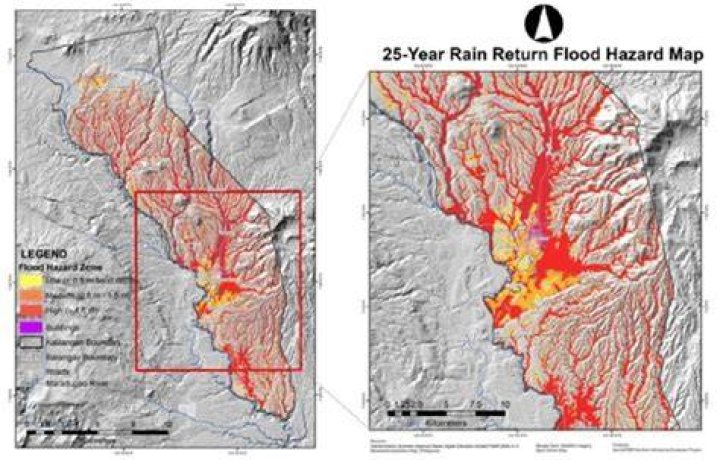
 Ava Hall