What is the energy of moving particles of matter?
 Ava Hall
 kinetic energy
.
Similarly, what is the energy of moving particles called?
Anything that is moving has kinetic energy, and the faster it is moving, the more kinetic energy it has. The total kinetic energy of moving particles of matter is called thermal energy.
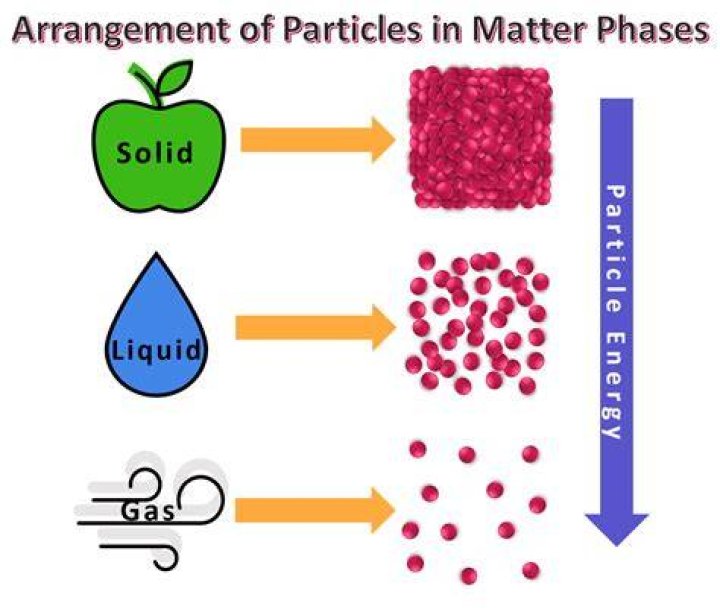
Furthermore, when you remove energy from particles they move? Energy added: particles move faster and further apart, and matter expands (state changes from solid to liquid to gas). Energy removed: particles move slower and closer together, and matter contracts (state changes from gas to liquid to solid).
Also know, how do the particles in matter move?
The states that all of the particles that make up matter are constantly in motion. As a result, all particles in matter have kinetic energy. The particles in a liquid, such as water in a pool, move much more freely than particles in a solid. They are constantly sliding around and tumbling over each other as they move.
Why do particles of matter move continuously?
Answer: Particles of matter move continuously because kinetic energy is present inside them. And particles of solids have the least kinetic energy in them. Particles of liquids have less kinetic energy than gases and more kinetic energy than solids.
Related Question Answers
What are some forms of energy?
Energy exists in many different forms. Examples of these are: light energy, heat energy, mechanical energy, gravitational energy, electrical energy, sound energy, chemical energy, nuclear or atomic energy and so on. Each form can be converted or changed into the other forms.Is heat a form of energy?
Heat or thermal energy is the form this energy possesses when it is being transferred between systems and surroundings. There is nothing material about heat. Heat is a form of energy that can be transferred from one object to another or even created at the expense of the loss of other forms of energy.What is the movement of particles in a gas?
Although we cannot see it or feel it, the particles are moving = vibrating in place. The particles in a liquid are close together (touching) but they are able to move/slide/flow past each other. The particles in a gas are fast moving and are able to spread apart from each other.What is the total energy of all particles in an object?
The faster the particles are moving, the more energy they have. Temperature is the average amount of energy of motion of each particle of a substance. That is, temperature is a measure of how hot or cold a substance is. In contrast, the total energy of motion in the particles of a substance is called thermal energy.How heat energy is produced?
Heat is produced by matter. Matter is made up of atoms and molecules and energy causes the atoms and molecules to always be in motion. They either bumping into each other or vibrating back and forth to cause energy. Which makes friction, which makes heat.What is a simple definition of heat?
In thermodynamics, heat means energy which is moved between two things when one of them is hotter than the other. That is, heat is defined as a spontaneous flow of energy (energy in transit) from one object to another, caused by a difference in temperature between two objects; so objects do not possess heat.What is heat and energy?
Heat energy is the result of the movement of tiny particles called atoms, molecules or ions in solids, liquids and gases. Heat energy can be transferred from one object to another. The transfer or flow due to the difference in temperature between the two objects is called heat.What are sources of heat?
Heating Energy Sources. Most radiant heating systems operate using warm water. Here are only some of your many choices for heating energy sources: natural gas, propane (LP), oil, coal, wood, electricity, heat pumps, ground source heat pumps and solar energy.What is evidence for particles in matter?
The evidence of the existence of particles in matter and their motion comes from the experiments on diffusion i.e. mixing of different substances on their own and Brownian motion. The zig-zag movement of the small particles suspended in a liquid or gas is called Brownian motion.What is the meaning of phase change?
1. phase change - a change from one state (solid or liquid or gas) to another without a change in chemical composition. phase transition, physical change, state change. freeze, freezing - the withdrawal of heat to change something from a liquid to a solid. liquefaction - the conversion of a solid or a gas into a liquid.What is the concept of surface tension?
Definition of surface tension. : the attractive force exerted upon the surface molecules of a liquid by the molecules beneath that tends to draw the surface molecules into the bulk of the liquid and makes the liquid assume the shape having the least surface area.How does temperature affect the movement of particles?
Particles move rapidly in all directions but collide with each other more frequently than in gases due to shorter distances between particles. With an increase in temperature, the particles move faster as they gain kinetic energy, resulting in increased collision rates and an increased rate of diffusion.What is in the space between particles?
Because the particles are moving about, a gas will fill any container that it is put into. Because there is space between the particles, they can be squashed into a smaller volume when the gas is compressed.What are the 12 states of matter?
The classical states of matter are usually summarised as: solid, liquid, gas, and plasma.
Low-energy states
- Solid: A solid holds a definite shape and volume without a container.
- Liquid: A mostly non-compressible fluid.
- Gas: A compressible fluid.
What are particles of matter?
PARTICLES OF MATTER DEFINITION. Matter is anything that has weight and takes up space. A particle is the smallest possible unit of matter. Understanding that matter is made of tiny particles too small to be seen can help us understand the behavior and properties of matter.What is the 5th state of matter?
Bose–Einstein condensate