Where is the savanna at?
 Ava Hall
 Africa
.
Also know, what region is the savanna in?
Savanna grasslands are found between tropical rainforests and desert. This includes areas such as Central Africa (Kenya), America and The North and East of South America (Brazil). What is Savanna? Savanna is similar to grassland but with scattered trees.
One may also ask, can humans live in the savanna? Originally humans lived in the Savanna biomes using its life as a source of food and materials. Humans have continued to use Savanna biomes in such a way even into modern times. The Aborigines of Australia continue in places to have a traditional Savanna hunter-gatherer culture even to this day.
Beside above, what is in a savanna?
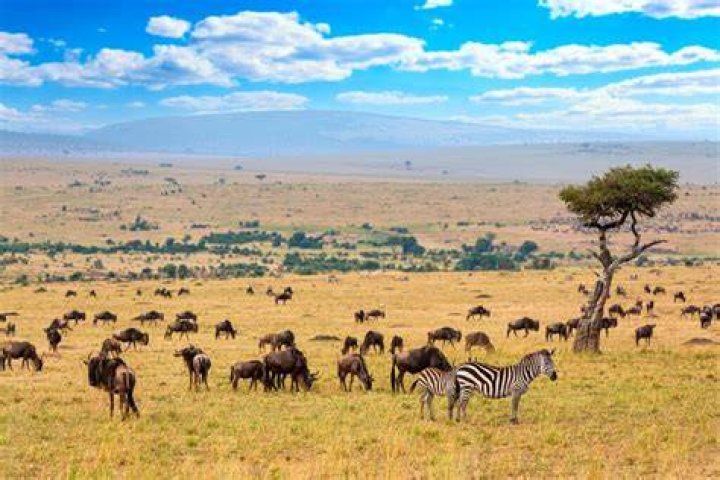
A savanna is a rolling grassland scattered with shrubs and isolated trees, which can be found between a tropical rainforest and desert biome. Not enough rain falls on a savanna to support forests. Savannas are also known as tropical grasslands.
What language is spoken in Savanna?
There are thousands of indigenous languages spoken in the Savannah some of these languages include:Amharic, Swahili, Kamba, Chichewa, Afrikaans, Zulu, Ndebele, Venda, and Swati. Through The Biomes Of Africa!.
Related Question Answers
What is the capital of savanna region?
Damongo
Is Savannah a jungle?
A savanna or savannah is a mixed woodland-grassland ecosystem characterised by the trees being sufficiently widely spaced so that the canopy does not close. However, in many savannas, tree densities are higher and trees are more regularly spaced than in forests.What is the climate of savanna biome?
The Savanna biome has a wet/dry climate. Its Köppen climate group is Aw. The Astands for a tropical climate, and the wfor a dry season in the winter. In the savanna climate there is a distinct dry season, which is in the winter.What is the largest savanna in the world called?
The vast savanna sweeping across more than 1.5 million square kilometres of Northern Australia is one of the greatest natural areas of the world. It is the world's largest expanse of savanna left in good condition, since globally ~70% of the area of original savanna has been lost.What is Savannah crop?
LOCATION: Savannas are comprised mostly of grasses and a few scattered trees. They cover half the surface of Africa, large areas of Australia, South America, and India. That is a lot of the earth's surface! Humans create savannas by burning grasslands and cutting down trees so they can plant crops.How does a savanna form?
In Africa, a heavy concentration of elephants in protected parkland have created a savanna by eating leaves and twigs and breaking off the branches, smashing the trunks and stripping the bark of trees. Elephants can convert a dense woodland into an open grassland in a short period of time.What is the difference between savanna and Savannah?
Savanna is a noun. It means large stretches of grasslands with few trees. Savannas are typically found in in the eastern parts of the African continent. [In British English, it is spelled “savannah.”Thanks Stuart Otway for pointing this out.]Is there water in the savanna?
Water. Water is necessary for all life, and the savanna grasslands are typically dry with little rain over the course of the year. Major rivers provide much of the water for the people of the savanna, and large population centers typically develop in these areas.Why is the savanna important to humans?
Forests and savannas are important ecosystemsThey sustain a lot of plant and wildlife. Tropical forests have exceptionally high animal and plant species. They also play a crucial role in regulating the global climate, for example by storing lots of carbon. And people make a living off forests.What makes a savanna unique?
The savanna biome is an area that has a very dry season and then a very wet season. They are situated between a grassland and a forest. They can also overlap with other biomes. There are savanna's located in Africa, South America, India, and Australia.What is life like in the savanna?
The people living in this biome are mainly farmers who grow cereals and other plants that can resist long dry spells, such as millet, sorghum, barley and wheat, as well as peanuts, cotton, rice and sugarcane, while breeding prevails in drier savannah areas.How much water is in the savanna?
Savannas typically get very little rain – about 4 inches (100 mm) of rain – in the dry season, and they will often not get any rainfall at all for many months. This is a long time for plants to go without water, which is why you don't see many trees. However, the wet season gets lots of rain.What is an example of a savanna?
Examples of Savanna GrasslandsWhen you hear the word 'savanna' you probably think of wide open spaces in Africa with lions, zebras, and elephants. Some of the most well-known savannas include the Serengeti Plains of Tanzania, the vast Acacia Plains of East Africa, the savannas of Venezuela, and the Australian Savanna.What is the African savanna like?
The African savanna ecosystem is a tropical grassland with warm temperatures year-round and with its highest seasonal rainfall in the summer. The savanna is characterized by grasses and small or dispersed trees that do not form a closed canopy, allowing sunlight to reach the ground.How do animals get water in the savanna?
During the dry season, surface water from the rain is quickly absorbed into the ground because the soil is extremely porous. Competition for water during the dry season is intense. Consequently, most birds and many of the large mammals migrate during the dry season in search of water.What percentage of the world is Savanna?
20 percent
How hot is the savanna?
Because it is in the tropical latitudes that is still hot enough. The savanna climate has a temperature range of 68° to 86° F (20° - 30° C). In the winter, it is usually about 68° to 78° F (20° - 25° C). In the summer the temperature ranges from 78° to 86° F (25° - 30° C).What color is the savanna?
The Savanna is a white goat.What can you do in the savanna?
What can you do in the Savanna?- You can go on a safari and see beautiful animals and plants.
- You can view the tribal life and visit African villages.
- You can go rafting on a beautiful river and have a lot of fun.
- You can enjoy really good traditional cuisine.