Which of the following is also called affective disorders?
 Ava Hall
 .
Subsequently, one may also ask, which of the following is an example of an affective disorder?
Some examples of mood disorders include: Major depressive disorder — prolonged and persistent periods of extreme sadness. Bipolar disorder — also called manic depression or bipolar affective disorder, depression that includes alternating times of depression and mania.
Likewise, what is unspecified mood disorder? Objective: According to ICD-10, the diagnosis of unspecified mood disorder (UMD), coded 'F39,' is used when there is insufficient or contradictory information about the patient and the symptoms of mood disorder are not sufficient to diagnose a specific mood disorder.
Accordingly, what is affective personality disorder?
Affective disorders may include manic (elevated, expansive, or irritable mood with hyperactivity, pressured speech, and inflated self-esteem) or depressive (dejected mood with disinterest in life, sleep disturbance, agitation, and feelings of worthlessness or guilt) episodes, and often combinations of the two.
What are mood disorders quizlet?
Mood disorders are disturbances of emotions that are severe or prolonged enough to cause impairment of functioning. These conditions are magnifications of our normal reactions. The magnified states in mood disorders are mania and depression. Mania - a period of abnormally high emotion and activity.
Related Question Answers
What are the types of affective disorder?
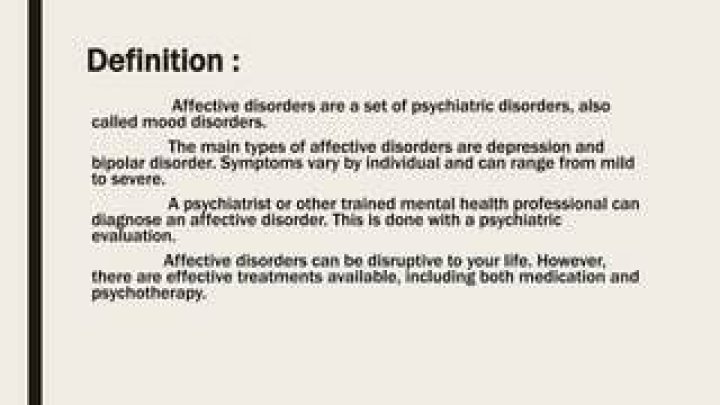
Affective disorders are a set of psychiatric disorders, also called mood disorders. The main types of affective disorders are depression, bipolar disorder, and anxiety disorder. Symptoms vary by individual and can range from mild to severe. This is done with a psychiatric evaluation.What are signs of mood disorder?
In addition to chronic low moods, common symptoms of this mood disorder include:- Feelings of hopelessness or helplessness.
- Trouble sleeping or daytime sleepiness.
- Poor appetite or eating too much.
- Poor concentration.
- Fatigue or low energy.
- Low self-esteem.
- Trouble concentrating or making decisions.
What is a mood affective disorder?
Mood disorder, also known as mood affective disorders, is a group of conditions where a disturbance in the person's mood is the main underlying feature. The classification is in the Diagnostic and Statistical Manual of Mental Disorders (DSM) and International Classification of Diseases (ICD).What are the 2 types of mood disorders?
The most common types of mood disorders are major depression, dysthymia (dysthymic disorder), bipolar disorder, mood disorder due to a general medical condition, and substance-induced mood disorder. There is no clear cause of mood disorders.Is ADHD a mood disorder?
Bipolar disorder is primarily a mood disorder. ADHD affects attention and behavior; it causes symptoms of inattention, hyperactivity, and impulsivity. While ADHD is chronic or ongoing, bipolar disorder is usually episodic, with periods of normal mood interspersed with depression, mania, or hypomania.What is conduct disorder?
Conduct disorder (CD) is a mental disorder diagnosed in childhood or adolescence that presents itself through a repetitive and persistent pattern of behavior in which the basic rights of others or major age-appropriate norms are violated.Is anxiety a mood disorder?
Is Anxiety a Mood Disorder? “No, anxiety is a feeling. Ohrt says, ultimately, depression and anxiety are not the same. They do have some overlapping symptoms including nervousness, irritability, problems with sleep and concentration.What are mood disorders dsm5?
Mood Disorders- Specifiers for Mood Disorders. DSM-5 includes multiple specifiers to describe the Bipolar and Depressive Disorders (Ref.
- Bipolar I Disorder.
- Bipolar II Disorder.
- Cyclothymic Disorder.
- Major Depressive Disorder.
- Persistent Depressive Disorder (Dysthymia)
- Premenstrual Dysphoric Disorder.
What is affective symptoms?
Symptoms of affective disordersSymptoms of major depression include feelings of sadness, loss of interest in normally pleasurable activities (anhedonia), changes in appetite and sleep, loss of energy, and problems with concentration and decision-making.What are the 3 types of personality disorders?
The types are grouped into three categories: Suspicious – paranoid, schizoid, schizotypal and antisocial. Emotional and impulsive – borderline, histrionic and narcissistic. Anxious – avoidant, dependent and obsessive compulsive.What is affective spectrum disorder?
The affective spectrum is a spectrum of affective disorders (mood disorders). It is a grouping of related psychiatric and medical disorders which may accompany bipolar, unipolar, and schizoaffective disorders at statistically higher rates than would normally be expected.Is bpd an affective disorder?
Traditionally, borderline personality disorder (BPD) has been considered as a threshold psychotic disorder [1]. Recently, it has instead been associated with affective disorders [2].What is difference between effective and affective?
The Difference Between Affective and EffectiveAffective describes something that has been influenced by emotions, is a result of emotions, or expresses emotion. Effective describes something that produces a desired result. Effective comes from the noun effect, which means result.What is psychotic symptomatology?
Psychosis is characterized by an impaired relationship with reality. It's a symptom of serious mental disorders. People who are experiencing psychosis may have either hallucinations or delusions. Hallucinations are sensory experiences that occur within the absence of an actual stimulus.Is OCD an affective disorder?
Some authors have proposed that OCD is in fact a mood disorder while others have suggested that the two disorders are grounded in negative affectivity. A third proposition is that depression is an essential part of OCD but that OCD is a separate disorder from depression.What is affective psychosis?
“Affective psychosis” is a term used to describe symptoms of psychosis that are present with mood episodes and most typically involve bipolar disorders or major depressive disorder. Bipolar disorders are defined by the experience of manic and depressive episodes.What does bipolar affective disorder mean?
Bipolar disorder, also known as manic depression, is a mental illness that brings severe high and low moods and changes in sleep, energy, thinking, and behavior. You can think of the highs and the lows as two "poles" of mood, which is why it's called "bipolar" disorder.How long do mood disorders last?
How long the mood lasts: A bad mood is usually gone in a few days, but depression lasts two weeks or longer.How do you fix mood disorders?
Try the following suggestions from experts for managing and coping with mood swings.- Control stress. Stress is a major bipolar trigger.
- Keep a regular schedule. Stick to a routine to help control mood swings.
- Practice healthy sleep habits.
- Get moving.
- Avoid caffeine, alcohol, and drugs.
- Write it down.